
Penn Township City Directory Shelves
Penn Township has no single historical resident roll. The useful historical-directory trail sits in Westmoreland County repositories and regional publications. The Greensburg Hempfield Area Library Pennsylvania Room is the strongest named shelf for directories, newspapers, census reels, church material, cemetery compilations, and an early wills index. Its published directory list covers printed Greensburg volumes beginning in 1913 and intermittently from 1927 through 1992, along with microfilm from 1909 through 1959 that has gaps. Regional print directories resume from 2000 forward. Treat those dates as collection coverage, not a promise that every Penn Township name appears in every volume.
| Collection | Years | Where Held | Access |
|---|---|---|---|
| Greensburg directory microfilm | 1909 to 1959, with gaps | GHAL Pennsylvania Room | Appointment research |
| Printed Greensburg directories | 1913; intermittently 1927 to 1992 | GHAL Pennsylvania Room | Appointment research |
| Greensburg and Latrobe print directories | 2000 forward | GHAL Pennsylvania Room | Appointment research |
| Wiggins Westmoreland directory | 1890 to 1891 | University of Pittsburgh Digital Collections | Free online catalog record |
| Irwin-area telephone volumes | 1952 to 1960 | Library of Congress | Digitized volume access |
Directories are uneven by design. A missing year can mean that the library does not hold that volume, publication was intermittent, or the person was not listed. It cannot by itself settle whether someone had moved, died, or lived under another name. Start with the volume nearest to the event date, then examine one earlier and one later issue.
Note: Appointment rules and holdings can change, so confirm the Pennsylvania Room’s current access conditions before a research visit.
Penn Township Directory Years at Pennsylvania Room
The Pennsylvania Room is an offline fallback when a web search stops at a catalog description. Its stated holdings include census schedules for 1790 through 1870, then 1900, 1910, 1920, and 1930, with the 1890 federal census loss clearly noted. The room also identifies newspaper runs, church and cemetery sources, directories, and an early wills index. A focused request works best: give staff a surname, a locality such as Harrison City or Level Green, a date span, and the kind of source needed. That gives the search a real historical frame without turning a postal label into proof of Township residence.
The Pennsylvania Room’s genealogy page lists holdings that are especially useful when a directory volume leads to a road, a rural route, or a small locality rather than a modern municipal address.
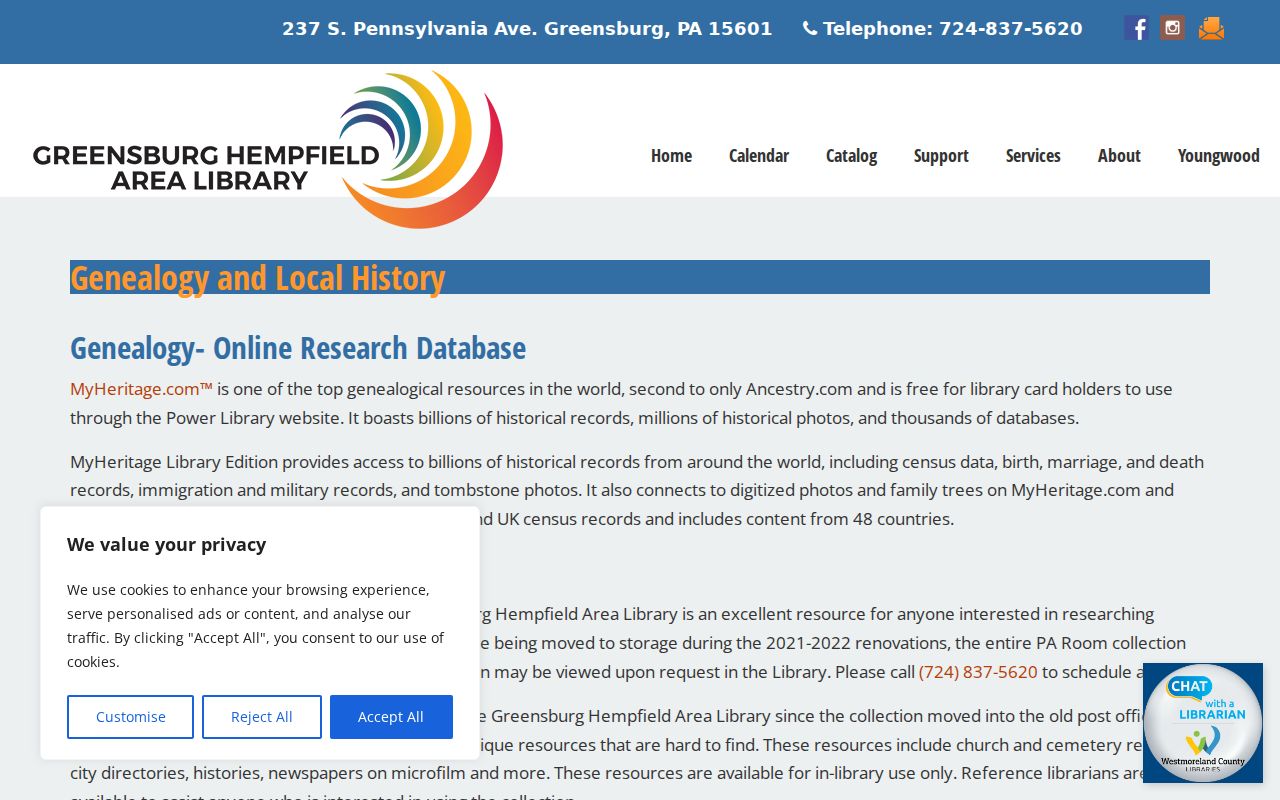
Use the listed holdings to choose a volume or reel by date. The image is a source landing page, not evidence that a particular person appears in a directory.
For a nearby local starting point, Penn Area Library research services offer a public-library and POWER Library pathway. Its public material does not publish a complete Township directory shelf, so the Pennsylvania Room remains the documented collection for the historical runs.
The Penn Area Library research page is a practical local starting point for catalog and database access.
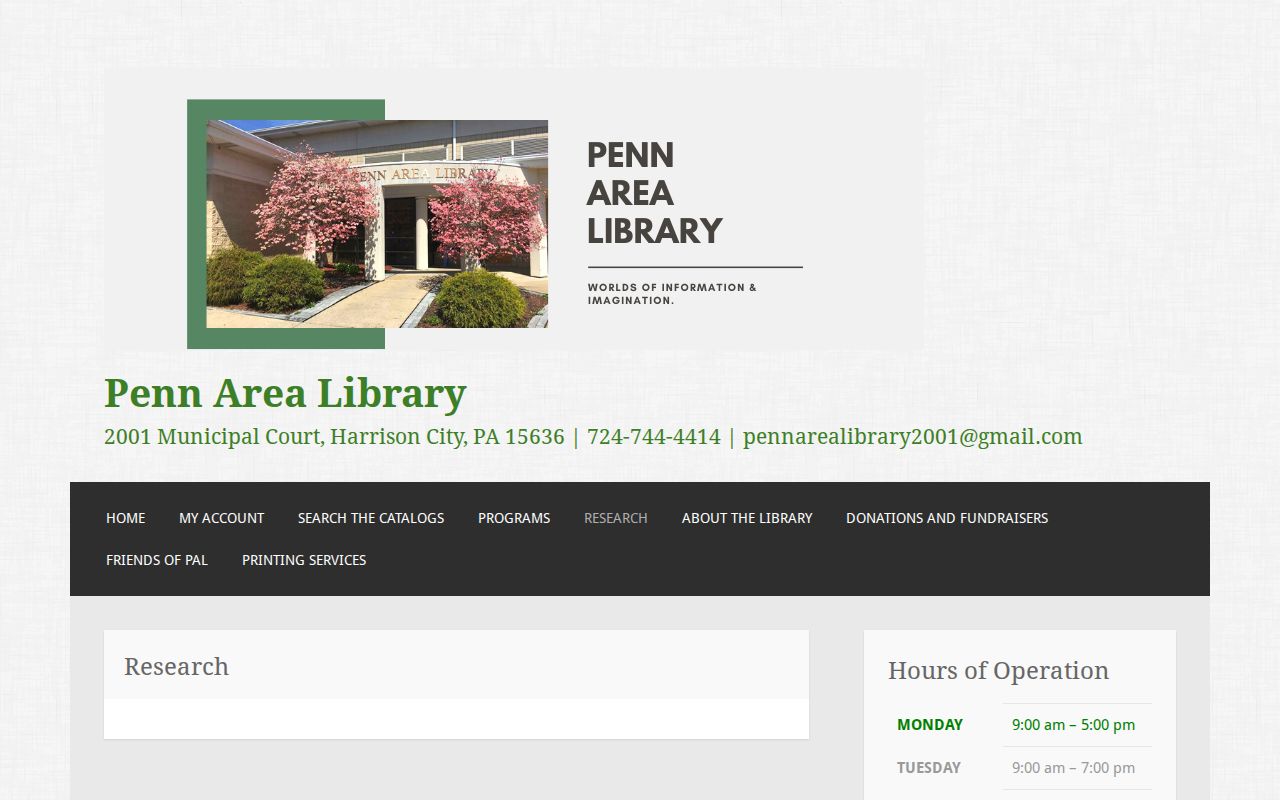
Use the library to ask a specific holdings question, then move to the Pennsylvania Room or Historical Society when the regional directory run requires it.
Reading a Penn Township City Directory
A directory entry is dated evidence. Read the volume’s front matter and abbreviation key before copying a name or address. Westmoreland entries may carry a surname, a given name or initial, an occupation when printed, a residence, a taxpayer or post-office clue, and sometimes a locality or rural-route reference. Telephone volumes can add a subscriber name and number. None of those fields proves present residence, ownership, every member of a household, or the current boundary of Penn Township.
| Surname and given name or initial | Record exactly as printed, then search spelling variants in another dated source. |
|---|---|
| Occupation, when printed | A period clue that may help separate similar names, not a permanent identity label. |
| Residence or rural route | A location clue for that edition; test it against a dated map and the volume’s abbreviations. |
| Taxpayer or post-office notation | Useful Wiggins context, but not a modern value, municipal boundary, or current address. |
| Subscriber notation | In a telephone volume, identifies the listed subscriber only and not every household member. |
- Criss-cross directory
- A street-order or reverse section, when a volume includes one, used to test a dated address association.
- Householder index
- An alphabetical listing arranged around the named household entry rather than a complete census of residents.
- Abbreviation key
- The volume’s explanation of shortened labels and symbols. Copy it with the entry before interpreting a route or residence mark.
When the goal becomes a modern parcel or street question, use the current address records on the Penn Township street directory rather than treating an old directory as a current record.
Wiggins’ Penn Township Directory Context
The University of Pittsburgh’s Wiggins directory record documents an 1890 to 1891 volume of 455 pages. Its city material includes names, occupations, and residences. For Township research, the record also supports taxpayer, post-office, and assessed-value context. That makes it a strong period source when combined with deeds, estate files, maps, and newspapers. It is not a complete Penn Township census, and an old assessed value should never be carried forward as a current value.
The University of Pittsburgh digital record describes this period volume. Search the catalog and its presentation tools with the exact historical spelling before assuming an absence.
A Wiggins hit supplies a dated clue that can be checked against the Recorder, the Register of Wills, or an archive source. It does not establish a present household or a full family relationship.
Penn Township Locality Labels in Directories
Historical city directories need a map check because the place name on an entry may be a postal convention. Penn Township sources repeatedly use Harrison City, Level Green, Claridge, Paintertown, and Grandview. Public facilities also use Irwin, Trafford, and Jeannette mailing labels. The Township lies in western Westmoreland County near the Allegheny County line, so a locality name can point toward the Township without proving an address lies inside the Township boundary.
Test the place in the dated volume, then compare it with a current County GIS boundary only for geographic orientation. The 2023 Township ward document is useful for roads, census blocks, borders, five wards, and eleven precincts, but it is not a historical directory or a time machine. Postal city, ward, precinct, parcel, and municipality serve different research purposes.
Note: Copy the locality exactly from the source, then record whether it is a postal label, a historic route, or a verified municipality.
Tracing Penn Township City Directory Households
Trace one household interval by interval. The goal is not to merge every similar name into one story. The strongest method records the directory year, page or image, exact wording, locality, and any uncertainty, then pairs it with a second independent record. For family history, that second source may be a census schedule, a recorded instrument, an estate file, a marriage record, a newspaper item, or a cemetery compilation. A modern record can verify a present question, but it cannot rewrite the date on a historical listing.
- Write down known spellings, initials, road clues, and a narrow date range.
- Choose the closest printed directory, telephone volume, or census reel, then copy the entry and its page reference exactly.
- Move one available interval backward and forward, noting a changed locality, route, or absence without guessing why it changed.
- Check the address or tract in a dated map and use Recorder grantor and grantee records for property continuity.
- Compare the period with a census year or Register of Wills material before connecting similarly named people.
- Keep a citation log that separates an exact statement from an inference still needing proof.
The 1890 census loss makes adjacent directories more valuable, but it does not turn them into a substitute census. The Pennsylvania Room’s directories and the Wiggins volume can help bridge that gap when their limitations are retained.
Penn Township Directory Searches Before 1855
Penn Township was incorporated on February 23, 1855 from parts of Hempfield, North Huntingdon, and Franklin Townships. A search limited to the present Township name can therefore miss an earlier record filed under one of those predecessor jurisdictions. Westmoreland County’s historical context reaches to 1773, and the Register of Wills reports estate records from that year. The broader Orphans’ Court historical assertion reaches to 1750. Use the source’s own date and jurisdiction rather than applying Penn Township backwards.
| 1773 | County historical collection scope and estate-record context begin in the published Westmoreland materials. |
|---|---|
| February 23, 1855 | Penn Township was incorporated from Hempfield, North Huntingdon, and Franklin Townships. |
| 1890 to 1891 | Wiggins supplies period directory and taxpayer context. |
| January 1, 1958 | Penn Township became a First Class Township after the 1957 vote. |
The First Class date explains the modern municipal classification. It does not establish where earlier records were kept. For older family work, the Westmoreland County Historical Society’s Pollins Memorial Library holds county-history and genealogy material, original documents, maps, and research support across the 1773 to present county context.
Honest Gaps in Penn Township Directories
No authoritative online finding aid was located for Township historical minutes, permit files, road records, tax duplicates, cemetery plats, or school records by year. No local courthouse-fire loss was documented for this research path. The well-known gap here is the national loss of the 1890 federal census, along with intermittent directory coverage. When a desired series is not online, ask Penn Area Library, the Historical Society, the Pennsylvania Room, or the Township for a tightly defined existing record or collection rather than requesting a general search.
Historical entries often need modern confirmation for a current question. A dated directory clue that needs present-day verification can be compared with official records through a Penn Township resident lookup, using the responsible custodian and a second source.